4 August 2026 — Shuang Li chases tornadoes across the American plains in order to film the storm we already live inside. Born in the Wuyi Mountains of China, she lives between Berlin and Geneva. Between March and June, she is spotted across Oklahoma and Arkansas, North America, driving with a small film crew towards the most dangerous weather, a season of spinning tornadoes. She learned the craft from meteorologists, riding along on their field research, and she has come nearer to the thing than most of them would like. Once the car she was in drove straight into this storm and it was dragged to the roadside, and dropped there. Had it been lifted instead she would not be making exhibitions.
Inside a spiral
The question a viewer arrives with is why a media artist cares about the sky over the Great Plains. Li’s answer is that a tornado and a screen behave alike. Both begin from something flat. The plains give you nothing to hold onto, same as the feed, and then a column forms out of the flatness and starts to turn, and everything near it goes up. You are scrolling, level and half bored, and then you are inside a spiral you did not choose and cannot leave, and it has your attention and will not hand it back. She chases the literal version because it lets her film the one, we live in.
Li did not come to fine arts from painting, but studied media and communication, first in China and then in New York. She was in Europe for a gallery show when the pandemic sealed the borders behind her, and she stayed, dividing her time since between two cities she has never quite warmed to. Europe, she complains, is slow. When she built a show for Prada in Shanghai, the materials she needed turned up at the door within half an hour. Nothing on this continent moves like that. For Basel she ended up freighting the whole exhibition over from Shanghai along shipping lanes that the recent conflicts in the Gulf Region had already tangled, a small reminder that the supposedly weightless digital world stays stubbornly physical.
Her leading character — the sex doll — arrived years before she turned to the tornadoes. The doll was imagined after a Chinese concubine, a woman kept as property, bought to use and dropped on a whim. Li carefully wrote a script on that and now this doll plays every role in her Basel films. In an earlier work the doll held a conversation with the historical concubine it had been modeled on, one object comparing notes with another across a few centuries. In 2015, fresh out of graduate school, she walked around Times Square in New York for six hours on Valentine’s Day under a placard that read “Marry Me for Chinese Citizenship”. The joke rested on a fact most passersby did not have, that China grants its citizenship to almost nobody and that a marriage will not change it. Reading only the shape of the request, an Asian woman offering herself for papers, a fair number of men stopped to propose the reverse deal and marry her for an American passport instead. They had the geometry backwards and probably never noticed, which was the work.
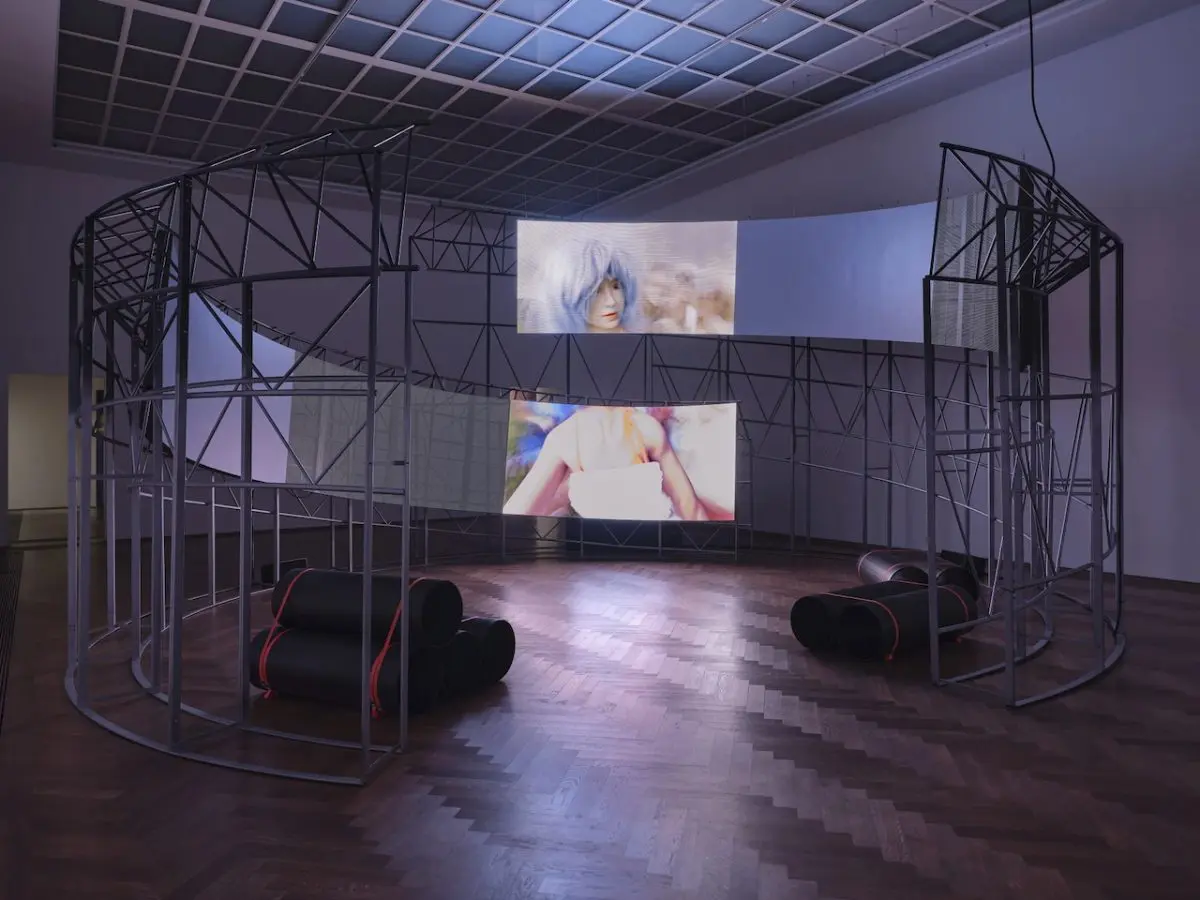
Inside the exhibition at Basel Kunsthalle
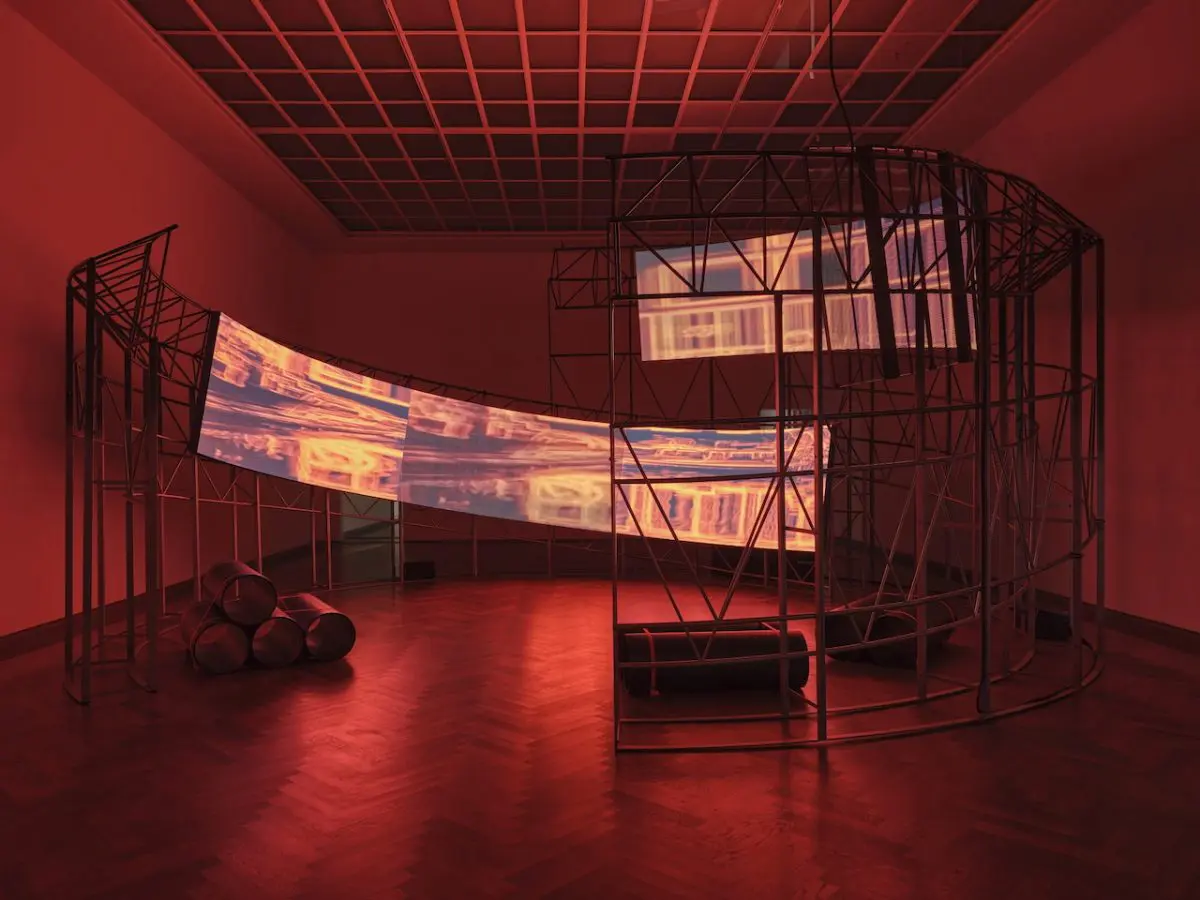
The exhibition “Alliance” (June 12 to September 13, 2026) takes over all five rooms at Kunsthalle Basel and turns them into a road. The temperature drops as you come in and the light slides from glare to gloom. The galleries are staged as the legs of one storm-chasing trip, building toward the funnel at the end. The first room holds “The Middle of the Day That Starts It All” (2026), thirteen screens strung along a twenty-seven-metre run of crash barriers that tilt toward the floor like the on-ramp to a motorway. The footage is landscape shot from a moving car, pushed until it stops resembling anywhere and starts resembling the colors you see behind shut eyelids. You are meant to feel the drive without ever arriving.
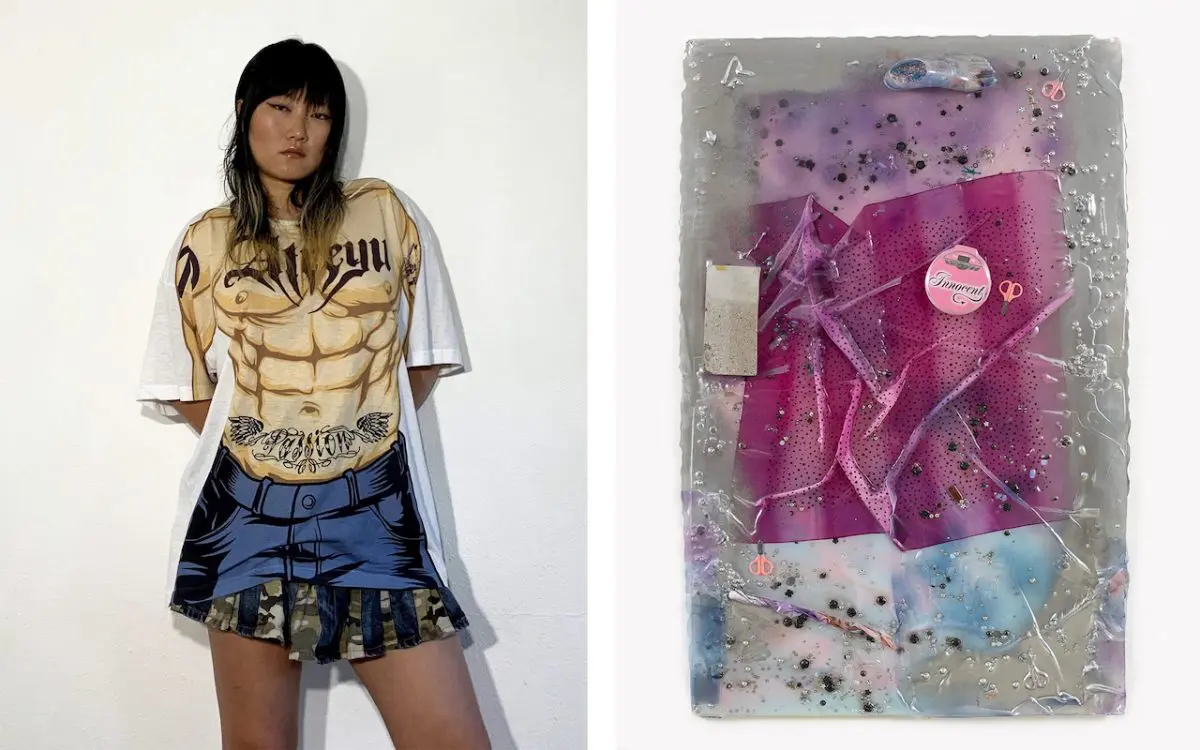
Further in, the pictures give up on holding still. A pair of billboard-scaled lenticular prints, “Fire at Will” and “Stolen from My Eyes” (2026), shift as you pass, so a weather map turns into a bruise and a stretch of road turns into a hand writing the word mommy. Another, “Interlude” (2026), lies broken across the floor in pieces like dropped pixels, with small sculptures cast from meteorological wind symbols settled on top, ordinary objects fixed in resin like water beading before a downpour. One room breaks the momentum on purpose. In “With a Trunk of Ammunition Too” (2024) a metal spiral hung with little lit tubes blinks out, in Morse code, a letter the artist wrote to her mother, so the single direct line to another person in the whole show reaches you as a coded light you have to know how to read.
Then the last room, where the weather finally lands. “Alliance” borrows its name from a real town in Nebraska where much of the film was shot, and the finale, “Alliance” (Heart Loop), closes you inside six screens and steel spirals that climb overhead as though the wind had set into girders. A car runs at a tornado. Gas stations and bare fields slide past, familiar and wrong at once. Three people are on the chase and one doll plays all of them, driving into the storm because she has been told she might come out the other side with some part of herself given back. Here the wall text says something ugly, almost as an aside. The doll was human once. She did not come off a production line. She was a person that the digital weather wore down into a thing, and the chase is her attempt to recover what it took. That is the detail that turns the show from science fiction into a mirror. The doll is not the alien in the room. She is the visitor, only further along.
Experiments on the defenceless
Placed beside the right ancestor, the point gets its edge. Half a century ago Marina Abramović stood still in a Naples gallery for six hours and let the audience use a table of instruments on her however it wished. By the end her clothes had been cut open and a loaded gun had been put in her hand. What that afternoon proved had little to do with art. It showed what people go looking for the moment a body in front of them stops registering as a person. Li has kept the demonstration and taken away the risk to herself. Her stand-in never counted as a person to begin with, or counted once and quietly stopped, which is the more ordinary tragedy and the one closer to home.
Today, artists no longer need to experiment with their own bodies as their predecessors did in the 1970s and 1990s; instead, they use technology to create their protagonists. Yet, human behavior toward the weak and defenseless remains unchanged. Li’s helpless doll continues to be subjected to abuse. Although the world moves forward, this progress seems to have no impact on human conduct. It is not only visual artists who contemplate the fate of humanity in the technological age; this theme permeates all genres. Artists, as Wassily Kandinsky already noticed, have always stood at the vanguard of society, perceiving things that remained inaccessible to others, including, it seems, the very creators of these robots. For example, in literature, Kazuo Ishiguro in “Klara and the Sun” explores the theme of robots designed to fulfill human emotional needs. Klara needs to satisfy the girl’s emotional needs; yet, in the end, as her young owner grows up, the doll is simply deactivated and left in the yard. In cinema, Hirokazu Kore-eda reflects on life amidst technological progress in his latest film “Sheep in the Box”. The plot — based on a real-life example involving a Chinese startup — depicts parents replacing deceased children with humanoid robots.
Here, too, humans wield absolute power, deciding whether to abandon or punish these artificial creatures. Ultimately, Kore-eda chooses a resolution in which the robot children are the ones to leave their parents, emphasizing peaceful coexistence rather than conflict. Not everyone, however, finds a happy ending; the doll of Shuang Li, housed in a Swiss museum, struggles to reclaim her agency and break free from the whirlwind of events surrounding her. The real-life endings to these stories have yet to be written; in art, however, the conclusion is that we create bodies we are permitted to love and to inflict pain upon, and then we ourselves observe what we choose to do.
There is a subtle irony in the fact that these themes are being explored by Li, who was educated in communications — a field that promised to explain how we find our way to one another. Yet she also studied technology, and therein lies a contradiction: the machines created to bring people closer together actually serve the exact opposite function. Perhaps these stories were never really about machines at all, but rather about people and their need for reciprocity and attention. The exhibition at Kunsthalle Basel is titled “Alliance” — a generous term to describe such a bargain.
Kino & Kunst
Cinema, art, and culture, since 2012.