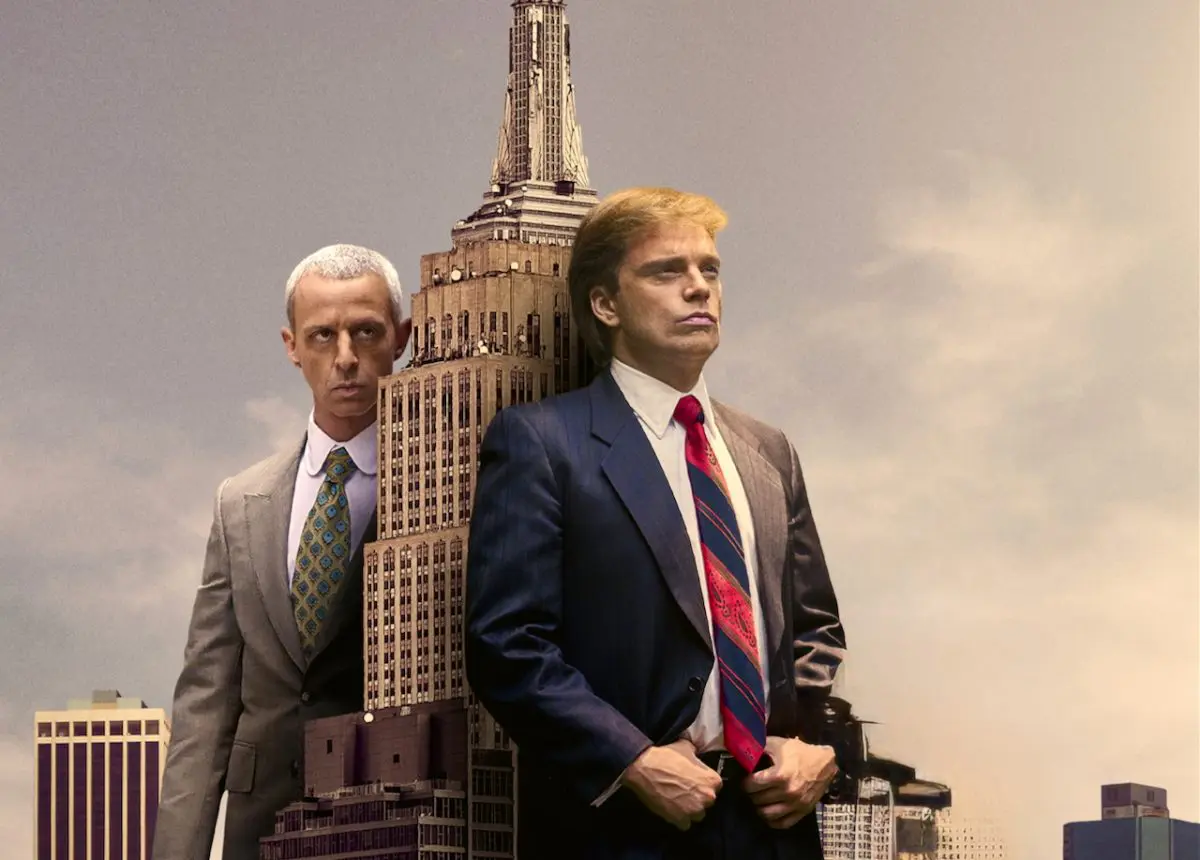
8 August 2026 — Films bring to life what the written word often cannot. On screen, scenes unfold as a tangible reality, even a fictional one. Two men descend a staircase into a windowless room where the reels of a tape recorder spin in the corner; here, other people’s conversations are monitored and recorded. The older man shows the younger one the hidden underside of the world. Then comes the story of a woman executed twenty years earlier: Ethel Rosenberg, convicted of conspiracy to commit espionage. Was she guilty? Perhaps yes, perhaps no. That is not the point. The execution served as a lesson. The specific reason did not matter. The death sentence was orchestrated by Roy Cohn, a young prosecutor who would later become one of New York’s most influential lawyers. People thought Rosenberg should be spared, if only because she was a mother. Cohn disagreed. For him “power” was the sole religion and “victory” the means of achievement. Twenty years later Cohn puts the story to use, making her an example for a young Donald Trump, twenty-seven at the time, so that he learns the one thing that counts: to succeed, whatever the cost. “The Apprentice” premiered two years ago. Back then people still wondered whether Trump, following his mentor’s lessons, would succeed. That is no longer a question.
“The Apprentice” is a modest title for the figure we now know. A prominent Manhattan developer and real estate tycoon, it is hard to believe he once began as an inexperienced youth. This film captures what made him. The story begins in 1973, where a young vice president of his father’s real estate company sits in an elite New York club on 55th Street making casual conversation with a model. His gaze, though, is fixed on those who possess what he wants most: money, power, fame. Within moments he receives an invitation to one of the VIP rooms, extended by a regular at the club, the renowned lawyer Roy Cohn. With that one invitation Trump finds himself among the influential and the powerful, forging connections and acquiring knowledge under his mentor’s guidance. Among his new acquaintances is Roger Stone, known for dirty tricks and political manipulation, who worked on Ronald Reagan’s 1980 campaign. Its slogan, “Let’s Make America Great Again”, would be adopted by Trump as his own during his presidential campaign.

According to Cohn, to succeed, one must be willing to do anything for anyone at any time. It is Cohn who gives Trump his three rules:
Attack, attack, attack. Never defend.
Admit nothing, deny everything.
No matter what happens, claim victory and never admit defeat.
In fact, all three rules boil down to a single idea: never yield to anyone on anything. There is nothing heroic about this, provided one defines the ‘hero’ as an adult who takes responsibility for their own actions and whose deeds benefit others. Cruelty becomes a core trait of the diligent student, directed not only at his mentor but at many close associates, once he attains the money and power he was after. But first Trump, still something of a wallflower, turns constantly to his powerful friend, asking him to make legal proceedings go away, among them a suit alleging discrimination against African-American tenants. The young Trump, played by the Romanian-American actor Sebastian Stan, has an irresistible charm. At times naive, he seeks the approval of a harsh father and courts his first love. With Cohn’s help he begins to realize his grandest ambitions, including Trump Tower, built after a planning commission meeting was manipulated to secure $160 million in tax breaks. The film shows how even then he became known for failing to pay his builders, ran into repeated business failures such as the Atlantic City casinos, and could neither devise effective strategies nor judge risk. His conduct towards women, in our own time, would end in court.
On September 1 a new biography of Roy Cohn appears, written by Kai Bird, who also wrote the biography of Oppenheimer. Both books became films that were widely discussed. This one marks another attempt in thirty years to make sense of the man. In 1992 Tony Kushner brought him to the stage; a documentary followed in 2019, then the feature film, and now a historical study. One might ask why Cohn again. Likely because the line runs to Trump, who owes much to him. Cohn was his gateway into New York society, a prominent figure with a client list of the city’s most influential names. At twenty-seven Trump came under his tutelage and was introduced to everyone who mattered. Under Cohn’s guidance he acquired the tactics of corruption and trade that both business and politics required. The return to Cohn is a constant attempt to understand the present, and the present keeps sending us back to him. Yet after a play, a documentary, a film and soon another biography, the questions remain. Each new version seems to attempt a closer look at a man whose life shaped the history we are living in.
Kino & Kunst
Cinema, art, and culture, since 2012.