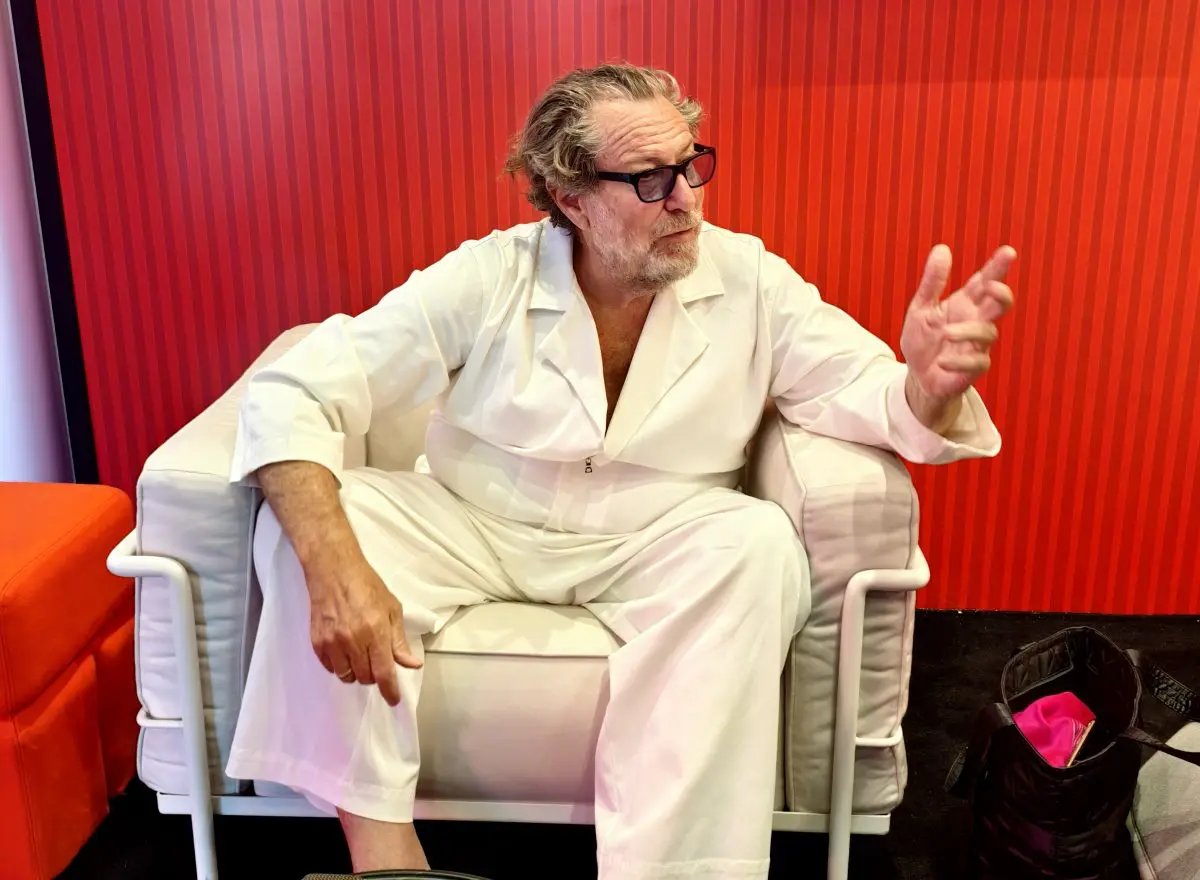
25 June 2026 —Julian Schnabel has spent five decades refusing to separate the painter from the filmmaker. Since the late 1970s he has been one of the most provocative figures in contemporary art — the broken-plate canvases, the surfaces of velvet and tarpaulin — before turning, in 1996, to cinema with Basquiat. Before Night Falls, The Diving Bell and the Butterfly, and At Eternity’s Gate followed, each treating a life as a kind of portrait: reconstructed through light, and texture.
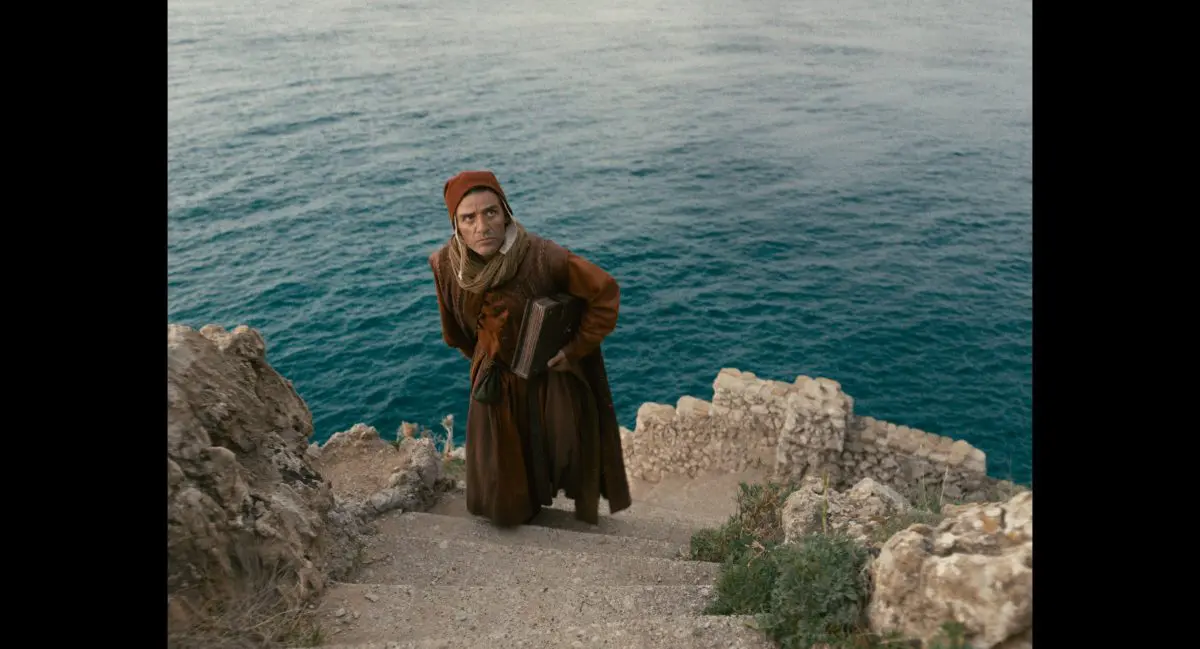
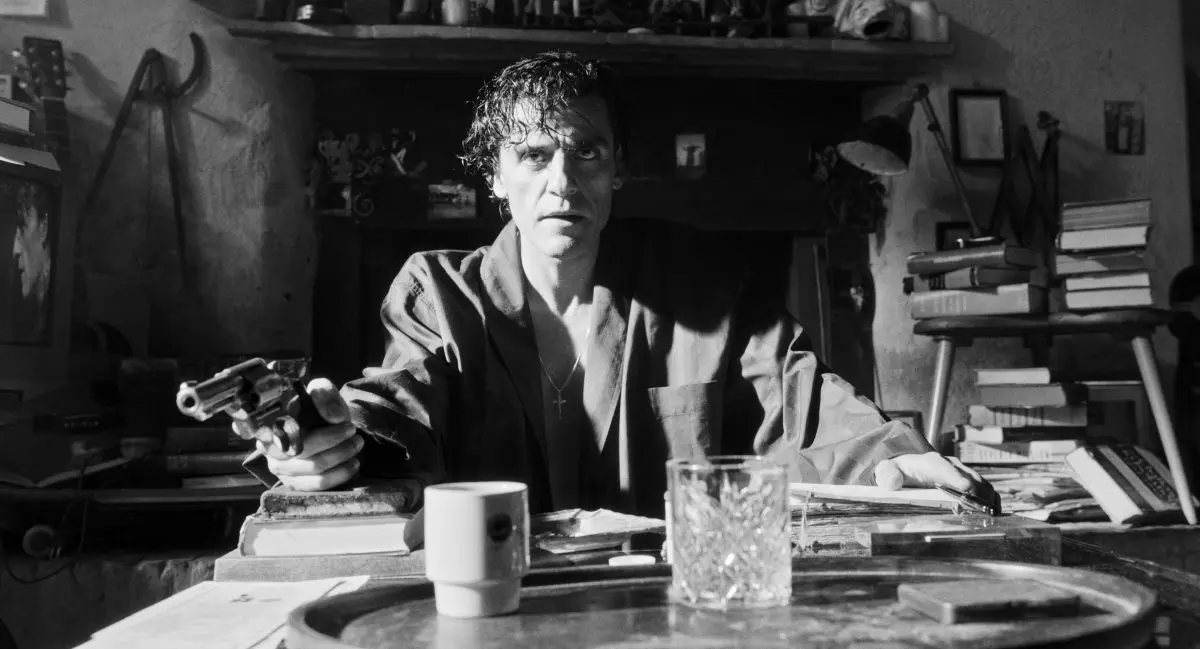
His new film, In the Hand of Dante, is the long-delayed adaptation of Nick Tosches’ 2002 novel of the same name, which moves between a noir-tinted present-day New York, shot in black and white, and a richly colored fourteenth-century Italy, with Al Pacino, Martin Scorsese, and Gerard Butler among the supporting cast. It premiered in Venice this past festival and opens worldwide on June 25. We spoke with Schnabel there, after the premiere.
How did “In the Hand of Dante” begin?
Twenty-five years ago, I made Before Night Falls with Johnny Depp. We’d been friends a long time and were always looking for something to do together. Around then he gave me Nick Tosches’ novel, published in 2002. It was the most impossible book to film, which is usually exactly what attracts me. I started adapting it, but life intervened and the project stretched across years. Johnny eventually stepped away, though Nick, who was still alive then, read the finished script and loved it. Oscar Isaac came in afterward; he told me he wanted something difficult and unusual, and ended up playing both a present-day writer and Dante, moving between centuries.
Your film mixes not just past and present, but noir, thriller, and comedy. What is it, in the end?
I’d call it a tragic comedy. Early in filming, things felt chaotic. I didn’t fully understand what I was doing. Then I thought: that’s it, that’s life. Funny, sad, tragic, inspiring, mad, at least for some of us. I was thinking of films like Random Harvest, about fractured identity and memory, and used a similar idea across two timelines: the same actors appear in the modern and the Dante-era story, so characters echo one another. It isn’t literal reincarnation, more a sense that identity and emotion repeat themselves through history.
How much of Dante’s Divine Comedy is actually in the film?
Don’t take the film as a thesis on the Divine Comedy. It’s a contemporary work about what art does, how it pulls you into its present the moment you encounter it. Churchill said you shouldn’t read certain books too young; Dante is taught in Italian schools far too early. Read it later, as an adult, and it stops being a medieval relic and starts working like a living system of images that reorganizes how you see the present. You begin to understand art’s ability to transgress death.
What do you think about parallel realities?
I believe there is no past and no future, only an eternal present, the simultaneity of time, in painting as in film. The past isn’t alive anymore; I can look at old photographs of myself, but that isn’t actually me being there. I’m only here, now. The future is simply whatever we do next; it doesn’t already exist. So, life becomes a series of real-time decisions about how you want to live. The only thing that truly exists is the work of art. That what remains, after we’re gone. There’s a line in the film: “You’ve lifted the veil on the inexpressible. You entered the sign. You’ve become the poem.” That’s all an artist wants — to become their work. When my friend Lou Reed was dying in my arms, I told him exactly that: you’ve become the poem. I think he was glad to hear it.
So how does an artist define the difference between art and life?
Art is a representation of life, and life contains death, but the representation does not. In that sense, all art is optimistic, even when its characters are tragic; it’s a kind of denial of death.
Why film the present in black and white and the past in color?
Why do what everyone else does? The modern characters — especially the gangsters actually look better in black and white; it also nods to films like Antonioni’s La Notte or Kubrick’s The Killing. But more than style, the modern world of this story feels like purgatory to me: people scrambling to survive, stuck in a moral in-between. Black and white suits that. The fourteenth century, the world of Giotto and the Scrovegni Chapel, is color. Life felt more direct then, more unified.
Al Pacino, Martin Scorsese, and others appear in your film. How did they come aboard?
They’re all close friends who wanted to support the film. Marty plays Isaiah, which is a small role but very essential. Dante comes to him for guidance and is told, “You can lie and go to hell, or tell the truth and be crucified.” I like placing familiar faces in unexpected roles. For example, Gerard Butler, usually the hero or the underdog, plays an assassin here, and people barely recognize him.
How does your experience as a painter inform your filmmaking?
My films come from a painter’s way of seeing, not from writing about things. I look past the frame; I don’t want the work, or the experience of it, to end when the film does. There’s a scene I ultimately cut, where a man asks what a Dante manuscript is worth and gets the answer: “There’s nothing like this. This is only this.”
What do you take from painting into film, and back again?
Painting alone can be liberating. No one to answer to. In At Eternity’s Gate, Van Gogh is asked why he paints, and he says, “To stop thinking.” Is that meditation? “No — when I paint, I stop thinking and become part of everything outside and inside me.” Painting carries its own lineage, Giotto to Caravaggio to Van Gogh to Pollock, the way cinema carries Antonioni, Kubrick, Tarkovsky, Scorsese — all working on you subconsciously. I work intuitively; I don’t illustrate what I already know. Then I return to ordinary life. My wife, who trained as an interior designer, curated my exhibition at the Musée d’Orsay. I was the first living artist shown there, and they let me decide how the works spoke to one another, almost like staging a conversation across history: Van Gogh, Cézanne, Manet, Courbet. Filmmaking, though, is its own kind of freedom working with talented people, letting their ideas bleed into yours instead of guarding your own, until you’re bleeding together.
Kino & Kunst
Cinema, art, and culture, since 2012.