
12 January 2026 — At first glance, Josh Safdie’s Marty Supreme may seem like yet another variation on the American Dream: the story of a man “from below”, obsessed with his craft and pushing forward against social indifference. Yet on closer inspection, it becomes clear that the film operates according to a very different logic, and it is precisely this divergence that accounts for the strongly polarized reactions it provokes.
The protagonist, Marty, is a fictional character inspired by the real-life table tennis player Marty Reisman, whose autobiography The Money Player (1974) loosely informed the film’s narrative. An American table tennis player, Reisman (1930–2012) began playing the sport at the age of nine following a nervous breakdown. He honed his skills by playing for money, taking part in betting matches that sharpened both his technique and competitive instincts. By the late 1940s, he had risen to national and international prominence, winning numerous major titles, including the British Open and U.S. championships.
In the film’s dramaturgical construction, the protagonist lives in 1950s America and chooses a path that was already considered socially pointless at the time: to pursue a marginal sport professionally, one that promised neither money, nor status, nor a stable future. The decision to set the story in the mid-twentieth century is fundamental to both the formation of the character and the film’s central idea. This is not merely an aesthetic gesture, nor an exercise in nostalgia for a supposedly clearer and better past, but a deliberate way of sharpening the central conflict to its limits.

Today, concepts such as “self-realization” and “individuality” have become part of everyday language and no longer surprise anyone. In that earlier era, however, the collective outweighed the individual, and virtue more often meant not standing out than expressing oneself or asserting difference. In a time before self-realization was recognized as a social value, Marty’s choice appears not simply eccentric but almost provocative. He rejects a “normal” life governed by the rule of conformity (“be like everyone else”, “earn money in the approved way”) in favor of an activity that society is not prepared to take seriously at all.
Josh Safdie, best known for Good Time (2017) and Uncut Gems (2019), returns to his favored type of protagonist: a man on the edge, living in a state of constant risk. Previously, that risk was directly tied to crime or gambling; here, it takes the form of existential stubbornness. Marty does not simply want to succeed — he cannot live any other way. His dream does not resemble a project with a predictable outcome; rather, it functions as an inner necessity, without which he loses his sense of self.
It is at this point that the film enters into a complex dialogue with the present. In a world of fragmentation, economic and ecological crises, and increasingly blurred visions of the future, the very idea of a dream begins to feel suspect. Where the old logic once promised “work hard” in exchange for recognition and stability, a different formula now prevails: risk, and risk again, without any guarantee of reward. Why? Because there is no alternative. Today, we have grown accustomed to the idea that effort no longer ensures results, and that “following one’s heart” is only feasible when supported by hidden safeguards — a financial cushion, social support, an option to retreat.

Marty Supreme does not shy away from this dilemma. Its protagonist exists within a harsh binary: remain faithful to himself, or choose safety at the cost of inner erasure. Stubbornness is not romanticized here; it is presented as a dangerous, at times destructive mode of existence, one that is backed by no guarantees whatsoever.
In this sense, the film offers neither comfort nor a model for imitation. It does not claim that Marty is right, nor does it promise that his choice will be rewarded. Instead, it identifies a human type: people for whom compromise with reality is experienced as a form of death. Existential stubbornness, in this context, is not a virtue but a last means of preserving subjectivity in a world where everything else is determined by external forces.
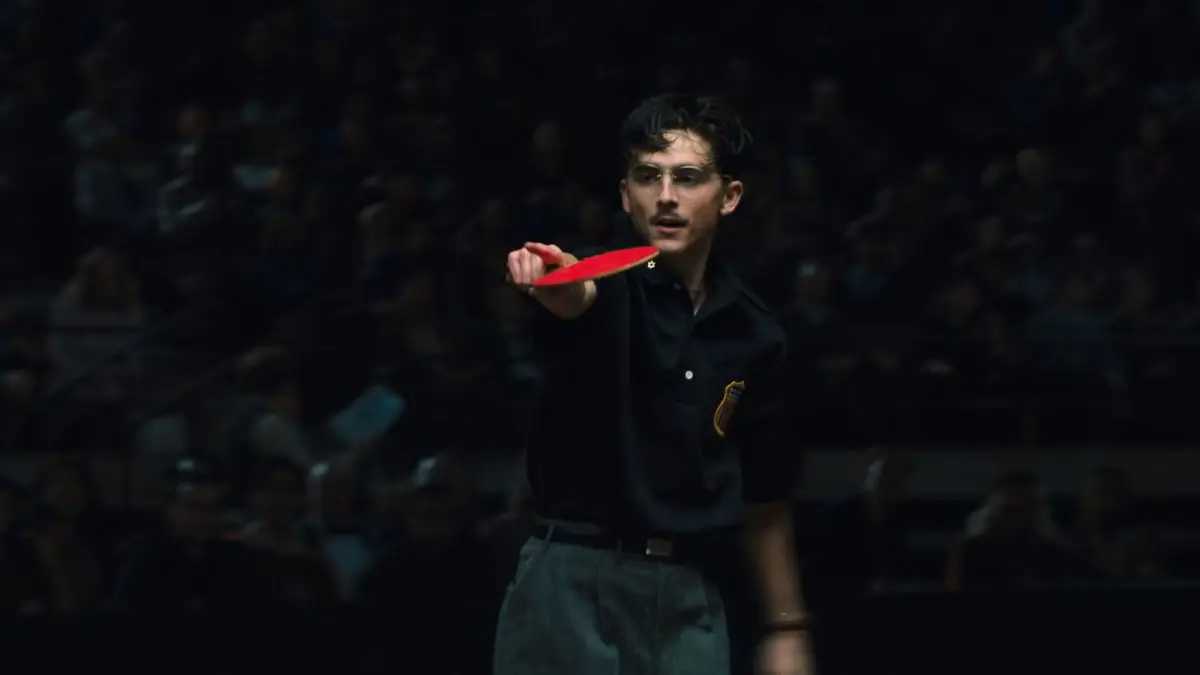
Safdie’s signature style is especially evident in the film’s unconventional take on the sports drama. Instead of the familiar narrative in which an athlete “overcomes everything,” the viewer is presented with a complex figure balancing between brilliance and self-destruction. Safdie wrote the role of the player specifically for Timothée Chalamet, believing the actor to be an ideal match for the character in both temperament and physical presence. Many critics have noted that this is one of the strongest and riskiest performances in Chalamet’s career. Here, the American actor abandons his familiar image of the introspective, fragile protagonist and portrays Marty as a nervous, impulsive, at times abrasive concentration of energy. His character is in constant motion, perpetually on the edge — between confidence and self-deception, charisma and despair. It is precisely this instability that makes the character feel alive and convincing, even when he provokes rejection. Chalamet won the Golden Globe for Best Performance by a Male Actor at the 83rd Annual Awards (January 11, 2026).
It is also significant that Chalamet appears almost anachronistic in this film: a contemporary type of sensitivity placed within the rigid world of the 1950s. This dissonance heightens the character’s sense of alienation, underscoring his untimeliness and vulnerability. As a result, the film becomes less a story about the past than a conversation about the present — about what remains for a person when the future no longer offers any promises.
Marty Supreme can easily be dismissed as weak or overrated, especially by viewers expecting clear ideas or emotional payoff. The film is worth watching for those interested in observing people without filters, for those not seeking a neatly articulated conclusion or a causal formula of “act this way and you will get this result”, and for whom mood and inner state matter more than explicit meaning.
The value of the film lies not in its conclusions. Rather, it functions as a symptom of its time, in which characters continue to insist on their own path even when the cost of that choice is unacceptably high. This may provoke irritation, doubt, and debate — reactions the director may well have anticipated.
Kino & Kunst
Cinema, art, and culture, since 2012.